Devlin Peck Reddit: What Critics Get Right (and What They Get Wrong)
If you searched my name next to the word "Reddit," you may have found threads with strong opinions about me. Some of that criticism is fair, and I say so on this page. Some of it is factually wrong, and I correct it here with evidence. Either way, you should not have to reconstruct the record from anonymous comments. This is the whole story in one place, from me, so you can judge it yourself.
I would like to clarify up front that this page is not an attack on Reddit. I got real help from the instructional design community there when I was starting out, and some of the criticism over the years has made my work better. I wrote this because people researching me deserve accurate information, including where the criticism is fair.
The timeline
My work has changed a lot since 2018, so a review of a $999 Storyline course from 2021 is not a review of Peck Academy in 2026. The history is important, though, so here is the whole arc:
- 2018 to 2021. I published free tutorials and articles, eventually preselling the ID Portfolio Bootcamp for $499 at the end of 2020. The launches that followed essentially sold out within a day, and I raised the price launch after launch, from $999 up through the mid thousands, trying to find the level where demand matched my actual availability. The Storyline Project Lab ($999) came in at the end of 2021.
- 2021 to 2023. The Bootcamp grew fastest during the years when huge numbers of teachers were leaving the classroom, and I marketed it hard. This is the era most of the criticism comes from. In 2022 I ran a short-lived subscription at $999 per month that included unlimited one-on-one feedback calls, and I grew a team to keep up with demand.
- 2023 to 2024. With the ID Project Lab added around 2023, the full ID Bootcamp curriculum peaked at $9,400, at a time when the hiring market for instructional designers was tightening.
- 2024 to 2025. We spent these years working through Oregon's licensing process and converting the Bootcamp into a licensed career school. In 2025, Peck Academy earned its license from the Higher Education Coordinating Commission as a private career school. We built an independent advisory committee and formalized our curriculum to meet state standards.
- 2026. My educational content and free resources have always been freely available; this year is about reclaiming devlinpeck.com as my free education hub, with no bootcamps or courses sold on it. Peck Academy now runs three tiers from $5,400 to $9,400. The content is the same at every tier; what varies is the level of support and feedback, and enrollment stays limited so our small team can deliver what we promise.
When people post about me on Reddit, it is helpful to know which years they are talking about.
My history with Reddit
I joined r/instructionaldesign in 2016, before I had any real credentials, and I asked a lot of beginner questions. People took the time to answer them. Some of the advice I got there still shapes my design decisions, and I have not forgotten that.
As I learned more, I started answering questions instead of asking them, and I shared the guides and templates I was building. Most of it was well-received. In 2020 a member posted a thank-you thread describing how the free articles helped them build a portfolio, roughly double their salary, and start interviewing for bigger roles. I also got into the technical weeds with the community, like this 2020 thread on xAPI. Threads like that are why I kept showing up. Eventually, I became a moderator of the subreddit.
However, as my paid programs grew, my relationship with parts of the community deteriorated. Threads about my marketing and pricing got sharper, and my presence in the subreddit became a distraction from the discussions I was there to have.
So, on January 8, 2022, I messaged the moderator team's private Discord that the subreddit had become a hard place for me and that I needed to step down. I also mentioned that it felt like a conflict of interest, because I had become part of what the subreddit was reacting against. Thirty-six minutes later I removed myself as moderator. The messages are below, with the other moderator's name redacted.
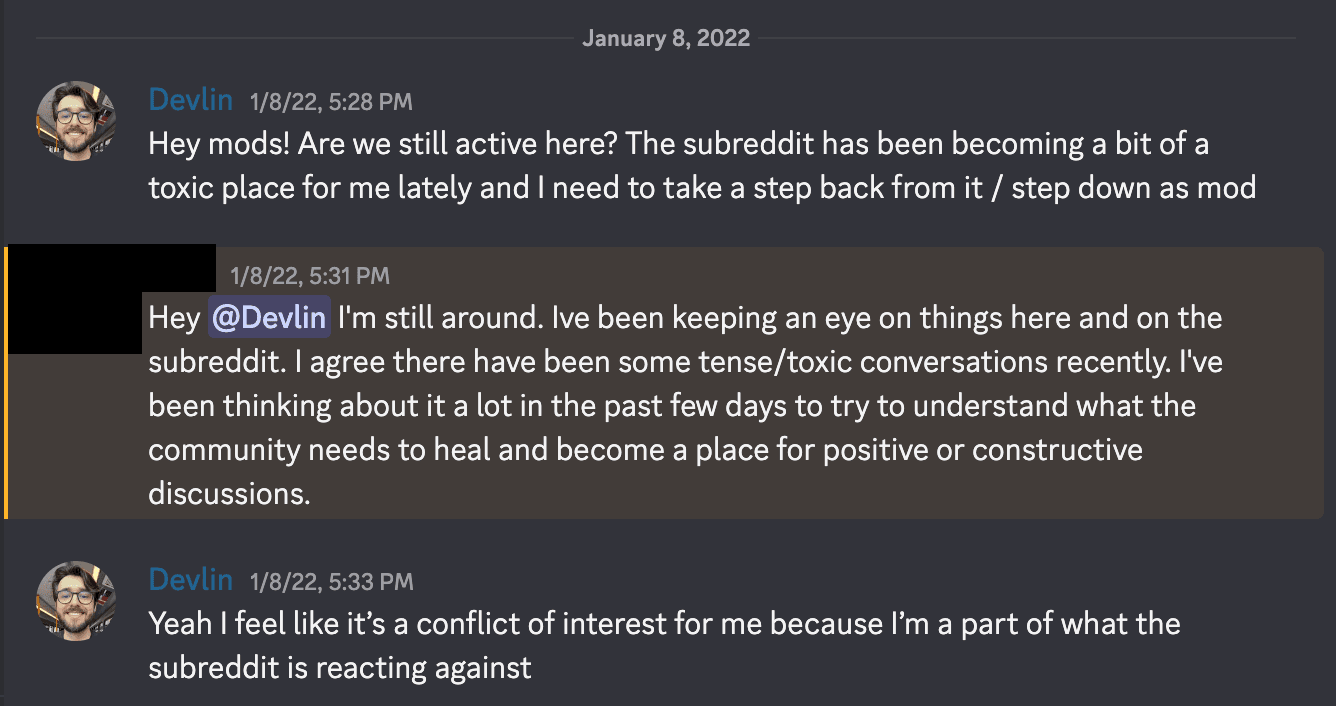

I eventually stopped participating altogether. It was distressing to see how people were talking about me, and taking a break from Reddit was better for my mental health than staying to share my perspective.
Today, r/devlinpeck is the official space I run on Reddit. My team and I share new content and start discussions there, and I read every comment.
The criticisms, one by one
I will address each criticism by sharing what people say, what was true, where I disagree, and what changed.
"The programs are overpriced"
What people say. Thousands of dollars to build a portfolio is indefensible when the information is available free.
What was true. The price climbed fast, and I was figuring it out as I went. The Bootcamp started as a $499 presale before the course was even built. The launches after that essentially sold out within a day, so I kept raising the price to find the level where demand matched what I could deliver: $999, then $1,999, then higher, until the full program peaked at $9,400. Price was the lever I used to keep enrollment at a size where people could still get unlimited feedback and mentorship from our team. But while the price was high (maybe comically so to people who didn't need that level of support), the core information was and is free, shared here on this site and on my YouTube channel. You do not need to pay me anything to become an instructional designer.
Where I disagree. Tuition was never buying secret information. It bought mentorship, feedback, accountability, and career support. People who wanted the information alone always had it free.
What changed. All of my educational content is free, with no email gates. Peck Academy is a licensed school with clearly defined tiers, and this paid path buys support, structure, and a credential (not information).
"He was selling a dream"
What people say. The marketing overpromised, especially to burned-out teachers who could not afford to gamble.
What was true. My Bootcamp-era marketing leaned harder on "financial freedom" outcomes and urgency than I would accept from myself today. I was excited by the growth of the business, trying to get better as a marketer, and wound up marketing too aggressively. My earlier copy deserved the criticism that it got.
Where I disagree. The program behind the marketing was real: projects, deadlines, feedback, portfolios that people built themselves. I also always made it clear to prospective students that it would take a lot of work to make the transition successfully, and that the bootcamp was not a free ticket to landing a role.
What changed. I no longer publish outcome claims I cannot document, and the way I substantiate results is stricter across everything I run. The section below on outcome claims explains my new standard.
"He has no real experience"
What people say. That I never worked as an instructional designer and built a career teaching something I never did.
What was true. I have not held a long, conventional, in-house corporate L&D job, and I've never claimed otherwise. Through college I worked in tech support for Apple, where I built training projects to help my teammates improve their metrics. From 2016 to 2017 I worked part-time at VSolvit, where I built online learning experiences and was promoted to Training Team Lead, leading a team of designers and developers.
Where I disagree. "Never worked as an ID" is false. I held that part-time ID role before graduate school, entered Florida State University's instructional design master's program in 2017, landed my first freelance clients before graduating, and was booked full time with client instructional design work by graduation. That grew into years of eLearning projects for household-name brands. Freelance and client work is instructional design work: it involved real stakeholders, real subject matter experts, real deadlines, and real deliverables, and I partnered with many more learning teams than I would've been able to as a full-time employee.
What changed. Nothing needed to change about the record, but two things are worth knowing about the present. Peck Academy no longer rests on one person's experience: a ten-person advisory committee helps keep the curriculum aligned with real corporate L&D work. And my own practitioner work continues through devlin.ai, where I work with Fortune 500 teams, alongside their directors and VPs, to design and roll out AI-powered simulation programs that tie learning initiatives to business goals. I also speak at industry conferences and corporate events; past and upcoming stops include ATD, The Learning Conference, Stanford, and DevLearn.
"He just teaches Storyline, and that is not real instructional design"
What people say. The programs are software tutorials dressed up as career training.
What was true. The most visible artifacts of my programs are Storyline projects, because portfolios are what get people interviews, and eLearning development is the most demonstrable skill in one.
Where I disagree. The process I teach starts well before the authoring tool: identifying the business problem, working with subject matter experts, action mapping, instructional design and strategy, storyboarding, and evaluating whether a solution worked. Tools are where that process becomes visible to a hiring manager, but they were never the whole curriculum.
What changed. Peck Academy's curriculum now runs the full span, from needs analysis through evaluation, and includes three live workshops every week: I lead the AI Project workshops, and our team leads the deliverable and Storyline workshops.
"The portfolios all look the same"
What people say. Graduates ship cookie-cutter portfolios that hiring managers recognize on sight.
What was true. Students follow the same process, so there is a resemblance.
Where I disagree. We used the process that works (on purpose). Design patterns exist because they make work easier to evaluate: a portfolio with a clear business problem, a documented process, and a finished deliverable is friendlier to a hiring manager than a novel format, the same way a well-structured resume is. I was not going to have students reinvent the wheel to prove a point. And a shared structure does not mean shared work. Every project was scoped, designed, and built by the student, and the portfolios that stood out did so because of the thinking inside them.
What changed. The process is the same because it still works. What is new is how far students can customize within it: students now use Claude Design to create their portfolios and devlin.ai to integrate AI-powered practice simulations into their flagship projects.
"I paid $999 and never got direct access to Devlin"
What people say. Storyline Project Lab buyers expected to work with me directly and felt misled when they did not.
What was true. Some early buyers expected more direct access than they received, and I understand the disappointment. When someone pays $999 because of a person's name, it can hurt to learn that you don't get 1-on-1 support from that person.
Where I disagree. One-on-one access to me was never part of that offer. The Storyline Project Lab was a $999 course with weekly group workshops with my team, and the workshops ran as promised.
What changed. Peck Academy's three programs (Foundations, Practitioner, and Professional Certification) state exactly what support each includes, so nobody has to infer the service standard from marketing. Students can get access to me at my AI Project workshops that I lead every week, and every tier includes support from a dedicated mentor on our team.
"I joined the Bootcamp and didn't get hired in six months"
What people say. People enrolled, six months passed without a job, and they concluded that the program failed on its own terms.
What was true. Some people counted the six months from the day they enrolled, and I should've had an enrollment agreement that laid out the terms more clearly. That ambiguity is on me, and I am sorry for it. If you spent your first months in the program thinking that you'd land a role within six months, that is a bad experience that I should have clarified with a clearer enrollment process.
Where I disagree. The commitment was always tied to completing the program: helping people get hired within six months of graduating, not within six months of signing up. The projects and the portfolio built during the program are what generate interviews and job offers. A hiring clock that starts before that work exists would not be based on anything real.
What changed. Peck Academy students now sign an enrollment agreement that defines the graduation date and criteria, the six-month window that starts at graduation, and the refund terms, all before any money changes hands. This ensures that all of the terms are clearly laid out before enrollment.
"Never trust a school with a hiring guarantee"
What people say. Guarantee language in career education is a sales tactic, and the fine print always wins.
What was true. As general advice, I agree; you shouldn't trust a hiring guarantee. Career education has a history of using this as a shady sales tactic. Read the terms of any program before you pay for it, including mine. I also own being sloppy with my marketing in years past, including "results guaranteed or your money back" on an old landing page. I wrote it because the people I was helping were getting hired quickly in a booming market, and my confidence outran my understanding of the standards for making that kind of claim. Tightening that language, and the evidence behind every claim we make, came later as I learned more about the history and standards in this market.
Where I disagree. Peck Academy does not offer a hiring guarantee. No school can promise you a job, and we do not claim to. What we offer on our top tier, the Instructional Design Professional Certification Program, is called the Peck Academy Promise, and it is written into the enrollment agreement you sign before paying: if you graduate in good standing, do the structured job search that the agreement lays out (a steady application pace, scheduled career-support meetings, and action plans after each one), and still have not landed a qualifying instructional design role within six months of graduating, we refund 100% of your tuition. The agreement also defines what counts as a qualifying role and names the specific market conditions, like a national recession, that can pause the promise. I would rather tell you that here than have you find it later. The requirements are not fine print designed to keep your money. They came out of the state licensing review, which pushed us to spell out exactly what is expected of graduates in order to earn this refund, and I would rather have explicit terms than not have this promise at all. The intent is simple: if the program does not deliver for someone who did the work, we do not keep their money.
What changed. The word "guarantee" has been gone for a while. The terms live in a signed agreement, reviewed by our state licensing office, instead of marketing copy, and the claims we make in public are ones we can document. Evaluate the terms the way that skeptical advice says you should.
"The whole thing is a sales funnel"
What people say. The free content exists to upsell you.
What was true. I started creating free content in 2018 because I wanted to save people time on the problems that were hard for me to figure out on my own. My hope was that the goodwill would possibly help me land some freelance clients down the road. However, as the Bootcamp grew in 2021, I realized that the people finding this content were the same people buying my bootcamp. I started trying to capture email addresses more aggressively and write email campaigns that would guide prospective students to apply to the program.
Where I disagree. I never expected everyone who joined my mailing list to join a paid program; however, we did create campaigns to try to turn good-fit potential clients into paying customers. My intent with the free content was always to help people as much as possible, for free, and I attribute all of my success in this industry to that. Building sales campaigns around the free content helped me grow the business, but it turned my site into somewhere I didn't even want to be (with popups asking me for my email address whenever I visited it). That's why the new version of my site is so important to me.
What changed. I got rid of the popups asking people for their email address, and I made it so that EVERY free resource on this site could be downloaded without entering your email. Since my other two businesses can do the selling on their sites, my devlinpeck.com site can reconnect with what I am most passionate about in this field: sharing as much value as possible, for free, for current and aspiring instructional designers.
"It is not even accredited"
What people say. The Bootcamp is an unaccredited program.
What was true. The Bootcamp was a fast-growing, creator-led program, and I never claimed it was accredited. It focused on helping people build portfolios and stand out in the job market; in the beginning, my focus was more on what helped people get hired than what would give them a comprehensive study of the field.
Where I disagree. Peck Academy, the program that the bootcamp grew into, is licensed by the Oregon Higher Education Coordinating Commission as a private career school. It is not nationally accredited, and I do not claim it is. Licensing means state oversight of how the school operates; accreditation is a separate, longer institutional process.
What changed. Peck Academy's curriculum is documented in a course catalog that anyone can download, it is reviewed with an advisory committee of ten independent industry experts, and we are accountable to our state licensing body. We may pursue formal accreditation in the future as our school matures.
How I handle outcome claims now
You will not find placement rates or salary statistics on this site, and I am removing undocumented claims like them from everything I run. The standard I hold now is simple: we make no outcome claims without documentation on record for that specific claim.
That standard did not exist in my early programs, and old marketing reflected it. The students who shared their stories told the truth as they lived it. I removed their salary claims because I do not have evidence that meets my current standard, and I would rather drop a claim than publish one I cannot back up with hard proof.
Where things stand
I am not asking anyone to stop criticizing me. Fair criticism improved my programs, my marketing, and this page. If you find something here that is inaccurate, tell me and I will correct it.
To the instructional design community on Reddit: the help I got there in 2016 helped me immensely, and I have not forgotten it. I stepped away because the temperature was more than I wanted in my life, not because I stopped caring about the field or the people entering it. If or when things calm down, I would genuinely like to be useful there again. In the meantime, my work is on this site, 100% free, and r/devlinpeck is where I share it on Reddit.